Black walls, blue hedges: the lines in the landscape
It is one of the first things you notice: the fields on São Miguel aren’t simply meadows, they are a patchwork. Every piece is enclosed — sometimes by a low wall of black stone, sometimes by a hedge. From above, the island looks ruled with lines.
The walls
The stones come from the field itself. Anyone clearing land here first had to get the basalt out of the ground, and where was it to go? To the edge, stacked up, without mortar. Over generations that produced thousands of kilometres of dry stone wall, doing three jobs at once: clearing the field, marking the boundary and keeping the wind off.
The third one matters most. Wind is the enemy of every plant here that grows taller than a blade of grass. On neighbouring Pico, the vineyards are divided into small stone squares for exactly that reason — a landscape that made it onto the UNESCO World Heritage list.
What grows on the walls
Look at a wall from a metre away some time. It is alive:
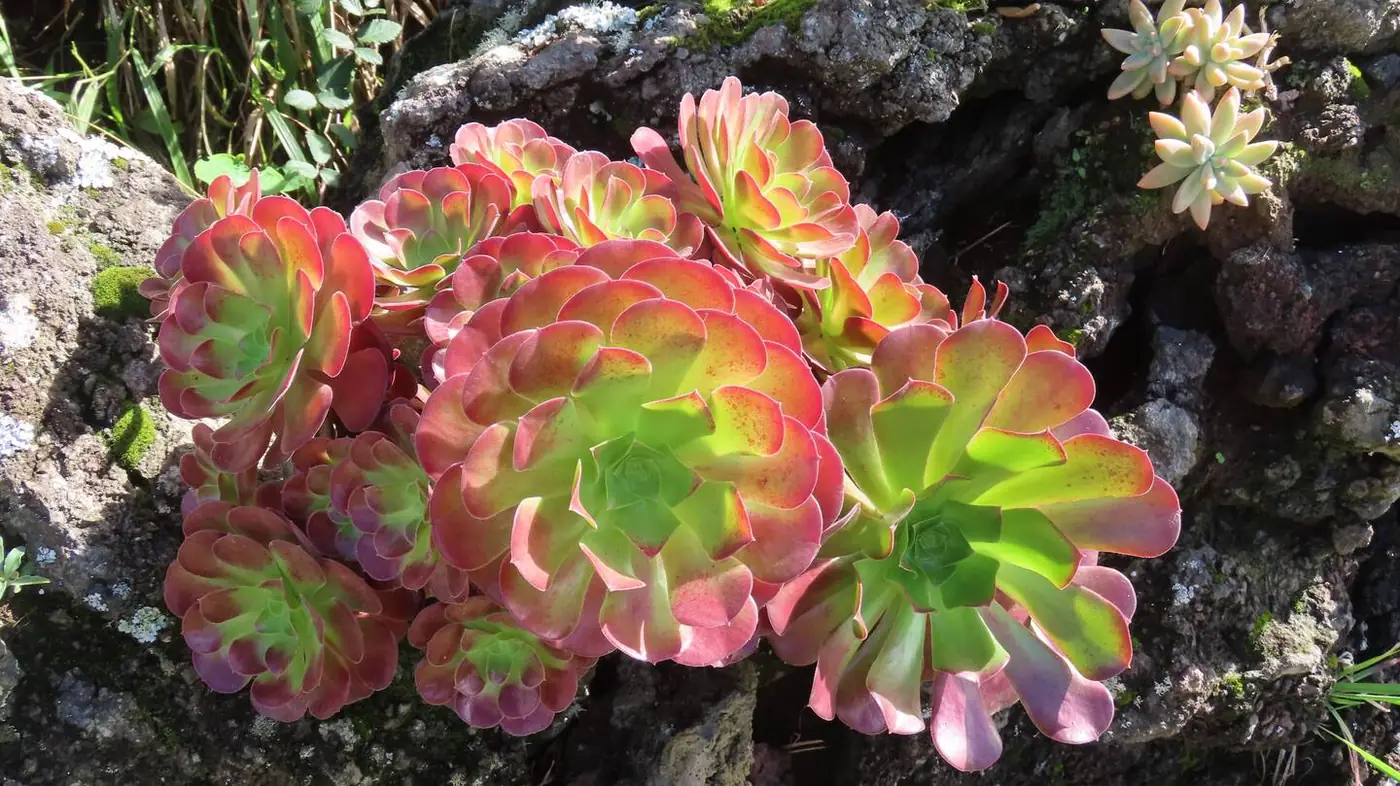
- Succulents with fleshy rosettes that turn red in winter and stay green in summer. They need almost no soil and no care at all.
- Lichens in grey, yellow and white. Lichens only grow where the air is clean — here they grow everywhere.
- Mosses and ferns in every joint that gets some shade.
A dry stone wall is, botanically speaking, a small habitat of its own. A rendered wall is a wall.
And the blue hedges
The hydrangeas the Azores are famous for are almost never growing where they are by accident. They were introduced from Asia in the 19th century and turned out to be the perfect living fence: fast-growing, dense, wind-proof and of no interest to cows. That is why they line fields and roadsides — a working plant that became an emblem along the way.
The blue, by the way, comes from the soil. Volcanic earth is acidic, and in acidic soil the plant takes up aluminium, which turns the flowers blue. In chalky soil the same shrubs would be pink.
Their season is June to September. Come in winter and you see bare stems — but then the black walls stand out, the ones that disappear under all the green in summer.
Here you can see when the house is free.
Frank, Bärbel, Maren & Simon